
Lexington Release Dates Explained
A projected date is a calculation made before release. It uses the sentence record, qualifying jail credit, statutory service rules, credit assumptions, and the relationship among sentences. An actual release date records an event that already occurred. SCDC uses those ideas in different places: its current-prisoner detail can display PROJECTED RELEASE DATE, while its separate Released Inmate Search displays Release Date and Release Type after a state-prison departure.
Lexington County Detention Center does not publish the SCDC projected field for local detainees. A pretrial detainee has no fixed sentence end to calculate. Bond, dismissal, a plea, a new hold, or another court order may change custody. A person serving a local county sentence can receive a calculation under the local-detention rules, but LCSD or the court must confirm it. Someone transferred to SCDC then follows the state sentence-record process.
Release is also not the same as discharge from all legal duties. Parole, probation, supervised reentry, or a detainer can remain after the person leaves one facility. Always read the release type and receiving authority along with the date.
Note: A date beside a current inmate is prospective; a date in the released list documents a past SCDC custody event.
Find a Lexington Release Date
Begin with the last known custody system. Lexington County cases can involve local pretrial detention, a county sentence, an SCDC sentence, or federal custody temporarily housed at the county jail. Each path has its own date source. Searching one locator repeatedly will not resolve a case that moved to another agency.
- Identify the facility and legal stage. Determine whether the person is pretrial, serving a local sentence, incarcerated in SCDC, or held under federal authority.
- For current SCDC custody, open the official detail and locate PROJECTED RELEASE DATE. Also note PROJECTED PAROLE ELIGIBILITY and SUP. REENTRY ELIGIBILITY without treating them as the same date.
- For a county detainee, check the Lexington court case for the order or sentence, then ask LCSD Inmate Information or the records office for the current release calculation.
- For a completed state-prison release, search SCDC's separate Released Inmate Search by date range and county LEXINGTON. Preserve the returned Release Type.
- Check SCDPPPS if the release type shows parole, probation, supervised reentry, or community supervision. Use the court or records office when dates conflict.
For LCSD questions, call the Inmate Information Center at 803-785-8230, option 2. A focused request can ask for the actual booking and release dates and times, release type, releasing authority, detainer, and transfer destination. For SCDC sentence questions, the Inmate Records Office number published by the state calculator is 803-896-8531.
The Lexington County release search and record process covers the full verification chain when the person has already left the roster. It is important because a current-custody search is designed for someone still held, while a release list or agency record survives the departure.
Lexington SCDC Release Date Fields
The ordinary SCDC inmate search covers people currently sentenced to and incarcerated in SCDC as of midnight the previous day. It expressly excludes people released from SCDC, county-sentenced inmates, people on parole or probation, other community supervision cases, and current SCDC fugitives. This limitation is decisive. A former prisoner is expected to disappear from the current tool.
The current detail can use three similar-looking labels. PROJECTED RELEASE DATE estimates the prison sentence end under the current record. PROJECTED PAROLE ELIGIBILITY marks when a qualifying person may enter parole consideration. SUP. REENTRY ELIGIBILITY relates to a possible supervised reentry stage. Eligibility does not promise approval or physical departure.
| Exact SCDC label | How to read it |
|---|---|
| PROJECTED RELEASE DATE | A computed current-prisoner planning date, subject to sentence and credit changes. |
| PROJECTED PAROLE ELIGIBILITY | The projected point for parole consideration when the law permits it. |
| SUP. REENTRY ELIGIBILITY | A projected eligibility marker for supervised reentry, not actual discharge. |
| Release Date | The past departure date in the separate Released Inmate Search. |
| Release Type | The state's event label, which may show continuing supervision or another release status. |
The official disclaimer shows the current-only scope and prior-midnight timing. Read the SCDC current-search source before interpreting a missing name.
The source makes clear that an SCDC current-search miss after release is expected, not proof that no state-prison record exists.
Note: County LEXINGTON in the state released list identifies the record's county classification, not the physical prison gate used.
South Carolina Release Date Inputs
South Carolina sentence computation starts with the court record, not a simple addition of sentence length to prison admission. South Carolina Code Title 24 Chapter 13 supplies the main time-credit rules. Section 24-13-40 generally begins computation at sentence imposition, subject to appeal, revocation, and court-designated rules, and requires qualifying presentence jail credit with stated exceptions. Sentence sheets, revocation orders, jail-time forms, disciplinary reports, and work or education records can all affect the calculation.
Section 24-13-100 defines a no-parole offense through the statutory offense classification and maximum punishment. For such an SCDC sentence, Section 24-13-150(A) creates the core truth-in-sentencing floor. Except for death and life cases, the person generally cannot receive early release, discharge, or the specified community supervision until at least 85 percent of the actual unsuspended term has been served. Good, work, and education credits cannot drive the release below that floor.
Other eligible SCDC prisoners follow different credit provisions. Section 24-13-210(A) authorizes a good-conduct deduction of 20 days for each month served for an eligible person who is not serving a no-parole offense, subject to conduct and forfeiture. Subsection (B) provides three days per month for qualifying no-parole inmates, excludes life and mandatory-minimum 30-year murder sentences, and cannot defeat a mandatory floor. Section 24-13-230 addresses work and education credits, including up to one day for two days of qualifying productive duty or education for eligible non-no-parole prisoners and a separate six-day-per-month framework for qualifying no-parole prisoners.
The SCDC release-date calculator uses the labels Earliest Possible Parole Eligibility Date and Earliest Possible Release Date. It assumes maximum good-time and work credits. The tool says its output is not official, does not provide an authoritative calculation for an already-sentenced individual, omits prior and later conviction complexity, and should not be used for Youthful Offender Act sentences.
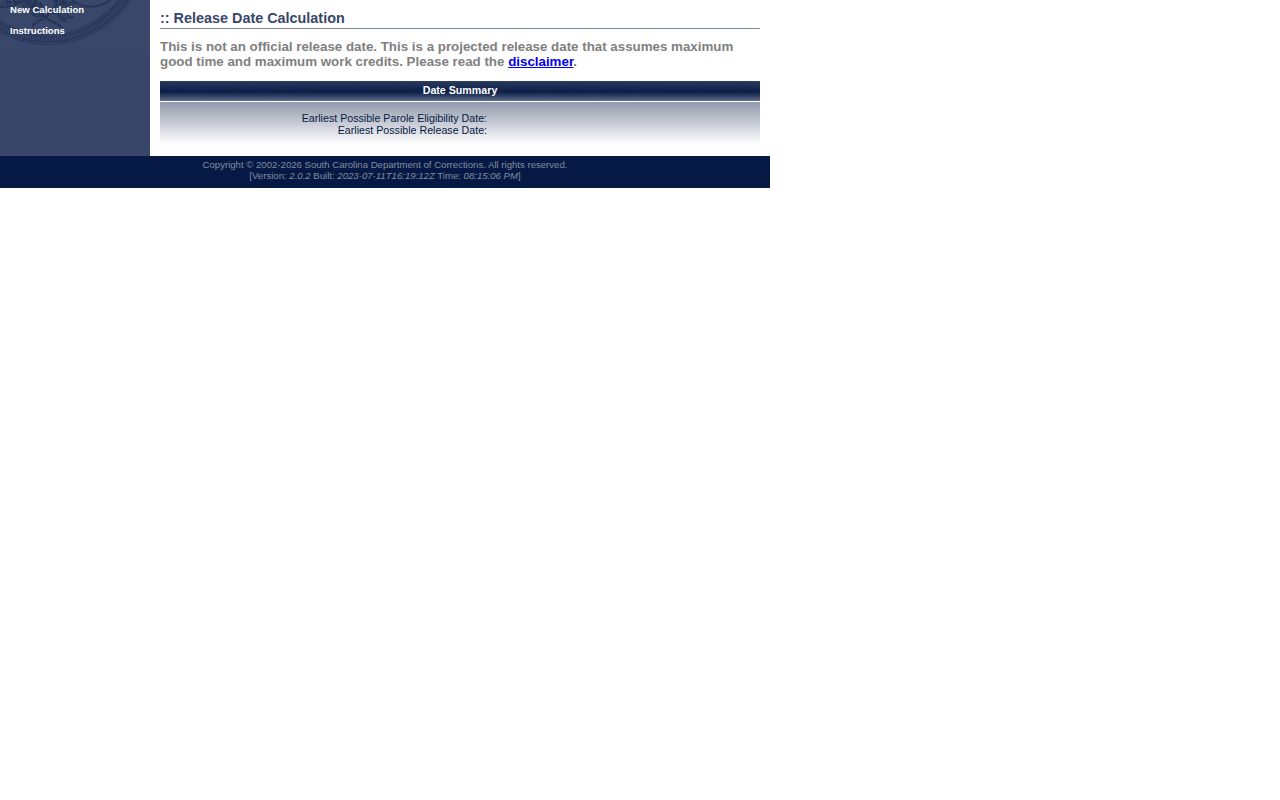
The calculator screenshot helps separate a general earliest-possible estimate from the PROJECTED RELEASE DATE maintained in an individual SCDC sentence record.
Lexington County Versus SCDC Dates
County and state sentences cannot be calculated as though they share one public field. Section 24-13-210(C) gives a person sentenced to a local detention facility or county public works one day of good-conduct credit for every two days served. Local officials may forfeit credit under subsection (D). This local rule applies to a sentenced inmate. It does not give a pretrial detainee a projected date and does not place a county sentence in the SCDC public detail.
A Lexington County pretrial detainee waits on court and custody events, not a statutory sentence countdown. Bond can authorize pretrial release, but the physical exit still depends on a valid order, payment where required, clearance of all charges and holds, identification, and jail closeout. Dismissal, acquittal, a plea, or transfer may change the path. The court record explains authority; LCSD confirms when county physical custody ended.
An SCDC prisoner has a state sentence record. Qualifying jail credit can enter that calculation, but SCDC also applies the offense-specific service floor, credit rules, sentence relationships, and disciplinary changes. A person convicted in Lexington County may serve at any SCDC institution. No active state prison is listed in Lexington County, so the state record's county label must not be mistaken for the release location.
| Person | Date source | Main limit |
|---|---|---|
| Pretrial county detainee | Court orders plus LCSD custody confirmation. | No fixed sentence end exists. |
| Sentenced local inmate | LCSD and the sentencing court. | Local credit calculation is not an SCDC public field. |
| Current SCDC prisoner | SCDC current detail and Inmate Records. | PROJECTED RELEASE DATE can change. |
| Former SCDC prisoner | SCDC Released Inmate Search. | Release Type may show continued supervision. |
When custody moved from LCSD to SCDC, the county event is a transfer, not release to the community. Follow the receiving state system. The reverse is also important: an SCDC result cannot serve as the release ledger for a county-sentenced person who never entered state prison.
Note: Ask LCSD or the sentencing court to confirm a local calculation; the SCDC calculator is not built for a county sentence.
Why Lexington Release Dates Change
A projected date reflects the sentence record at a point in time. New verified inputs can move it. SCDC policy says that a posted disciplinary good-time loss updates the projected release date the next day. Other changes can arrive through courts, jail-credit review, a new sentence, or a hold from another authority. A later date does not always mean a new conviction, and an earlier date does not prove immediate release.
| Change | Possible effect on release date |
|---|---|
| Disciplinary credit loss | Can move the projection later after the loss posts. |
| Failure to earn assumed credits | Can remove time that an earlier projection expected. |
| Corrected sentence or jail credit | Can move the date in either direction after the record is fixed. |
| Concurrent or consecutive terms | The latest controlling concurrent end or the sequence of consecutive terms governs. |
| Mandatory minimum or 85-percent floor | Overrides an earlier credit-based projection. |
| Detainer, court order, appeal, or revocation | Can delay departure, change custody, or alter the operative sentence. |
Concurrent sentences run at the same time, though their individual ends can differ and the latest controlling date matters. Consecutive sentences run one after another. A detainer is a request or hold from another authority. It can mean that release from SCDC or LCSD becomes a transfer to another agency rather than freedom in the community.
Do not calculate an individual's date from these general rules alone. Offense date, offense type, mandatory minimum, suspended time, jail credit, appeals, revocations, and policy inputs can change which statute applies. SCDC Inmate Records or the sentencing court is the proper source for an individual dispute.
Verify Lexington Actual Release
Parole eligibility is not a projected release promise. Under Title 24 Chapter 21, qualifying modern nonviolent cases may reach consideration after one-fourth of the term, while eligible violent cases may reach it after one-third or the mandatory minimum, whichever is longer. Certain long or life terms can use a ten-year point, but offense-specific exclusions, no-parole laws, mandatory minimums, and offense dates govern. Good-behavior deductions do not calculate parole eligibility, though qualifying earned work credits may apply.
A person can become eligible and still receive no grant. A scheduled hearing only starts a decision stage. Even a Board grant must be followed by the formal release process and accepted conditions before physical departure. After release, SCDPPPS can supervise parole or another community status. The Lexington County parole and probation record explains that later supervision check.
Use the SCDC Released Inmate Search for the actual state-prison event. Enter a beginning date, ending date, and county LEXINGTON, then scan or export the results. The visible fields include SCDC ID, Name, Sex, Race, Age, Sex Offender Indicator, Release Date, Release Type, and County. Preserve a returned type such as PROBATION or SUPV RE-ENTRY because it shows that prison custody ended into a continuing legal status.
The official date-and-county form shows why the release list is not a direct name locator. Begin with a narrowed date range at the SCDC released search.
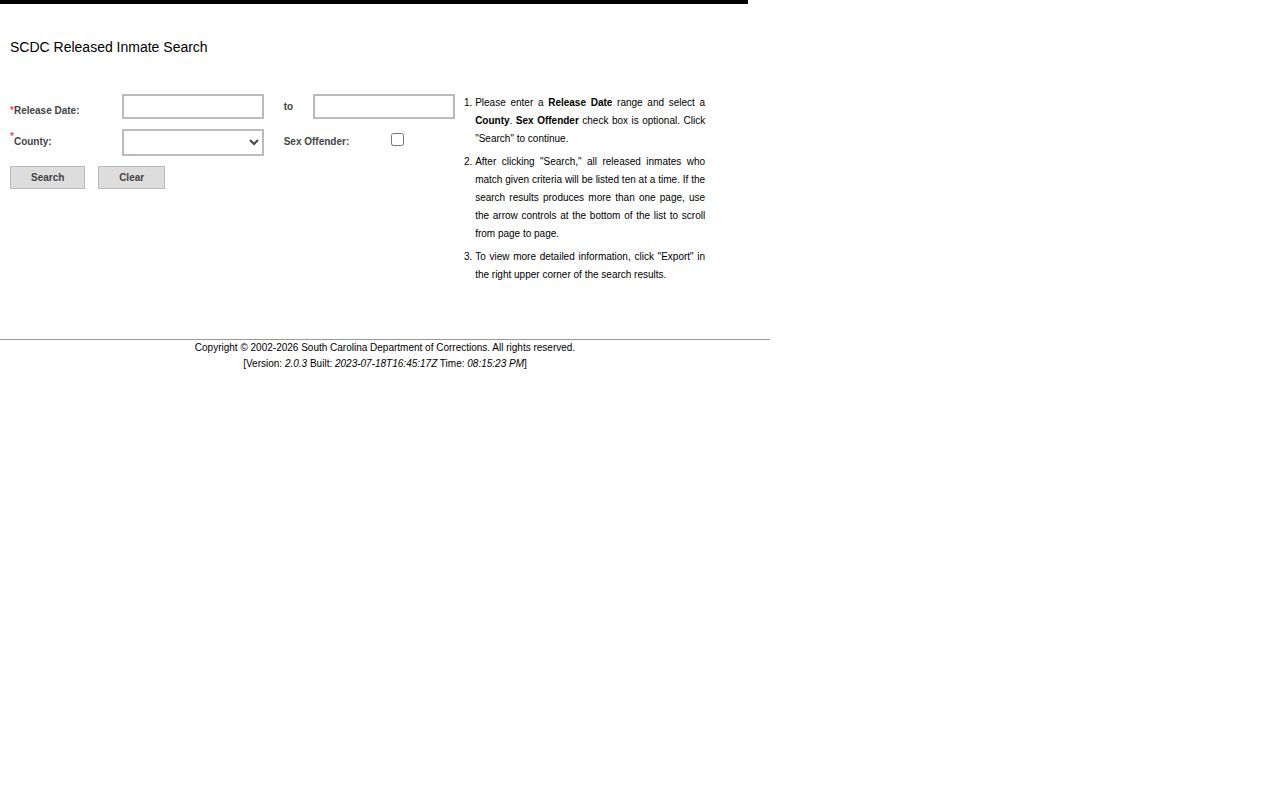
The state form documents a completed SCDC departure, while LCSD records remain the correct source for an actual Lexington County jail release.
The safest hierarchy is simple. Use a projected date for planning. Use the Board record for a parole decision. Use the SCDC released list for actual prison departure. Use SCDPPPS for ongoing state supervision. Use LCSD and the court for a county release or local sentence. If federal authority controls the person, use the federal docket, USMS, or BOP record instead.
Note: Release Type is as important as Release Date because it can identify probation, supervised reentry, or another continuing status.